
The True Cost of Network Downtime at a Concrete Plant
Most plant managers have a number in their head for what downtime costs. It's usually wrong — and almost always too low.
When the network goes down at a ready-mix concrete plant, the visible cost is obvious: trucks sitting in the yard, dispatchers on hold, customers calling to find out where their concrete is. But the real cost runs deeper than what you can see in the first hour. By the time systems are back online and you've tallied everything up, a single downtime event at a mid-size concrete operation can easily reach five figures.
Here's How Those Numbers Actually Add Up
The Direct Costs Start Immediately
The moment your dispatch system goes offline, your operation stops taking orders. If you're running Command Alkon, Trimble, Jonel, or Dispatch360, that platform is the central nervous system of your plant. Without it, you can't ticket loads, you can't confirm deliveries, and you can't communicate accurately with drivers in the field.
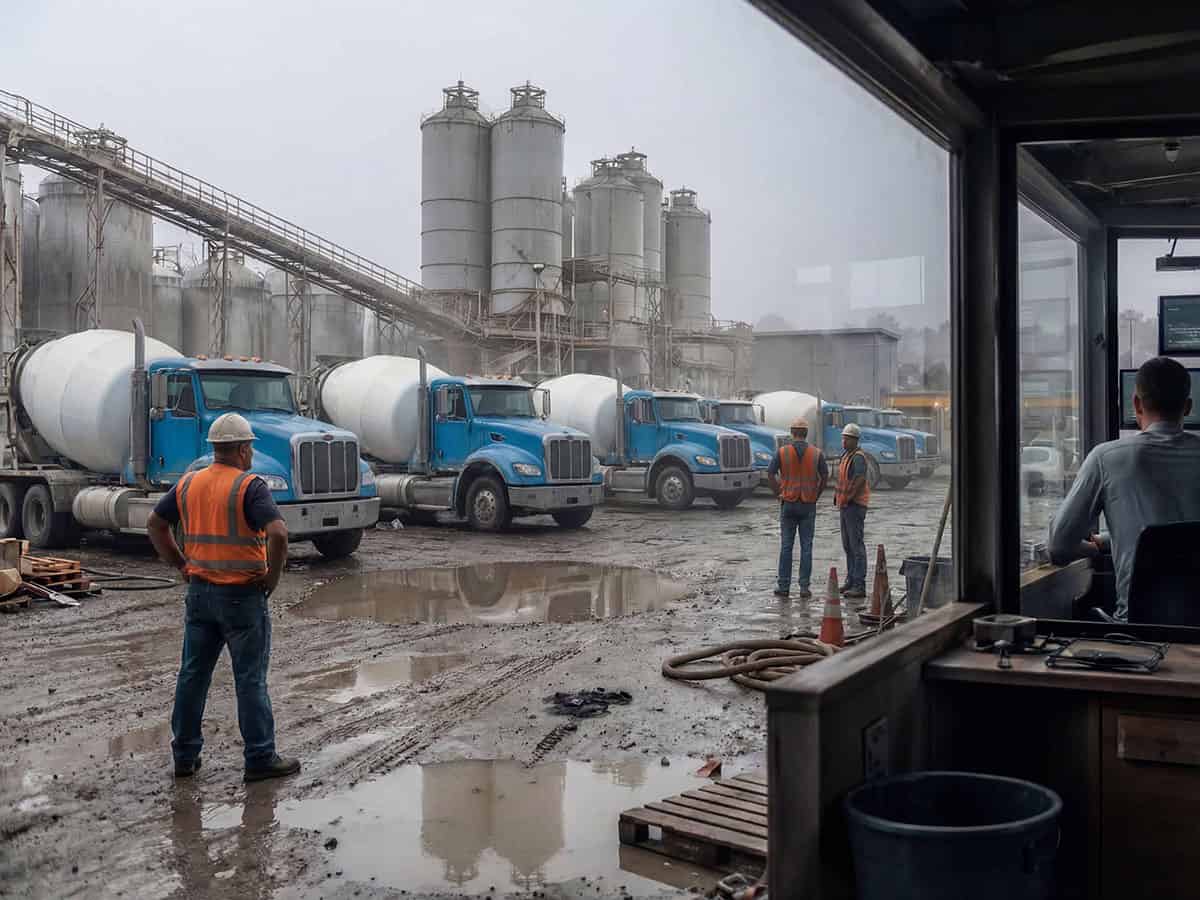
A ready-mix truck that should be on its third load of the day is now sitting. Drivers are being paid. Equipment is burning fuel at idle. A conservative estimate for a 10-truck fleet sitting idle for two hours is $3,000 to $5,000 in direct labor and fuel costs alone — before you account for a single missed load.
And that's assuming the downtime happens during a slow period. If it happens on a pour day — when a contractor has a crew standing by and a structural deadline to meet — the cost calculus changes entirely.
The Pour Day Scenario
Concrete doesn't wait.
When a contractor has a foundation pour scheduled and your trucks are late because your dispatch system is down, the consequences extend well beyond that single job.
Concrete already in the drum has a working window. Depending on temperature, mix design, and additives, that window can be as short as 60 to 90 minutes. A two-hour outage during a pour day doesn't just cost you a delivery — it can cost you the material in the drum, the labor on the job site, and in some cases, the remediation if a pour was started and couldn't be completed.
Now add the contractor relationship. A concrete producer's reputation is built almost entirely on reliability. One bad pour day caused by an IT failure tends to generate the kind of conversation that follows you to the next bid. If you want to understand the full scope of what's at stake for a ready-mix operation when technology fails, our IT services for ready-mix concrete producers page walks through exactly what we protect and why it matters.
The Costs Nobody Talks About
Direct costs are the easy part to calculate. The harder costs to measure are the ones that show up weeks later.
- Staff overtime. When systems come back online after an outage, someone has to reconcile the tickets that were manually tracked, re-enter data that didn't sync, and sort out the billing discrepancies. In a plant running 150 loads a day, that's not a 30-minute cleanup.
- Customer credit requests. Contractors who experienced delays will often request credit on their next order. A legitimate request, but one that compounds the cost of the original outage.
- Emergency IT costs. If the outage happened outside business hours and you called someone for emergency support, that bill reflects it. Emergency rates from reactive IT providers can run two to three times standard hourly rates — and the minimum engagement is typically four hours.
- Compliance and documentation gaps. For operations with state DOT contracts or other regulated work, missed or incomplete delivery documentation during a downtime event can create compliance issues that take weeks to resolve.
What Proactive IT Changes
The difference between a reactive IT model and a managed IT services model isn't just response time — it's whether problems get caught before they become outages.
A managed IT provider monitoring your environment 24/7 sees a failing hard drive before it fails completely. They see a server resource creeping toward its limit before it causes a crash. They see a switch port throwing errors before it drops connectivity to your dispatch terminal. The foundation of all of that is a properly designed and monitored network — which is why LAN and WAN management is the starting point for any serious concrete operation.
None of that happens with break-fix IT. Break-fix IT starts the clock when you call — after the damage is already done.
For a concrete operation running 200 days a year, even preventing two significant downtime events annually covers the cost of managed IT several times over. The math isn't complicated. The decision to act on it is the harder part.
The Bottom Line
Network downtime at a concrete plant is not an IT problem. It's a production problem, a customer problem, and a revenue problem that happens to have an IT cause.
The question isn't whether your operation can afford managed IT. It's whether it can afford not to have it.
If you want to know what your operation's downtime risk actually looks like, start with a free IT threat assessment. We'll show you exactly where the vulnerabilities are — before they show up in your production numbers.