
Why Ready-Mix Concrete Plants Need a Dedicated IT Partner
There's no shortage of IT companies. In most markets, you can find a dozen managed service providers within a 30-mile radius willing to take your monthly retainer. The problem isn't availability — it's fit.
A general IT company can keep your computers running. What they can't do is walk into your plant and already understand why your batch controller matters more than your accounting server, what happens to your operation when your dispatch terminal loses connectivity at 4 AM, or how Command Alkon's database structure affects the way you should be managing backups.
That gap — between generic IT support and specialized IT support — is where concrete and aggregate operations consistently get burned.
The Software Problem
Ready-mix concrete operations run on specialized software that most IT providers have never seen. Command Alkon, Trimble, Jonel, Five Cubits, and Dispatch360 manage dispatch, batching, ticketing, and delivery confirmation for billions of dollars of concrete every year. They're not standard enterprise software. They have specific server requirements, specific network dependencies, and specific failure modes that require specific knowledge to diagnose and resolve.
When something goes wrong with your Command Alkon server at 5 AM and you call a general IT provider, the first 20 minutes of that conversation are spent explaining what Command Alkon is and why it matters. By minute 30, you're still no closer to a resolution — and your first truck should have left the yard 10 minutes ago.
A dedicated IT partner for the concrete industry already knows what you're running. They know the database architecture, the common failure points, the network requirements, and the fastest path to resolution. The difference in response quality isn't marginal. It's the difference between a 30-minute fix and a three-hour outage.
The Environment Problem
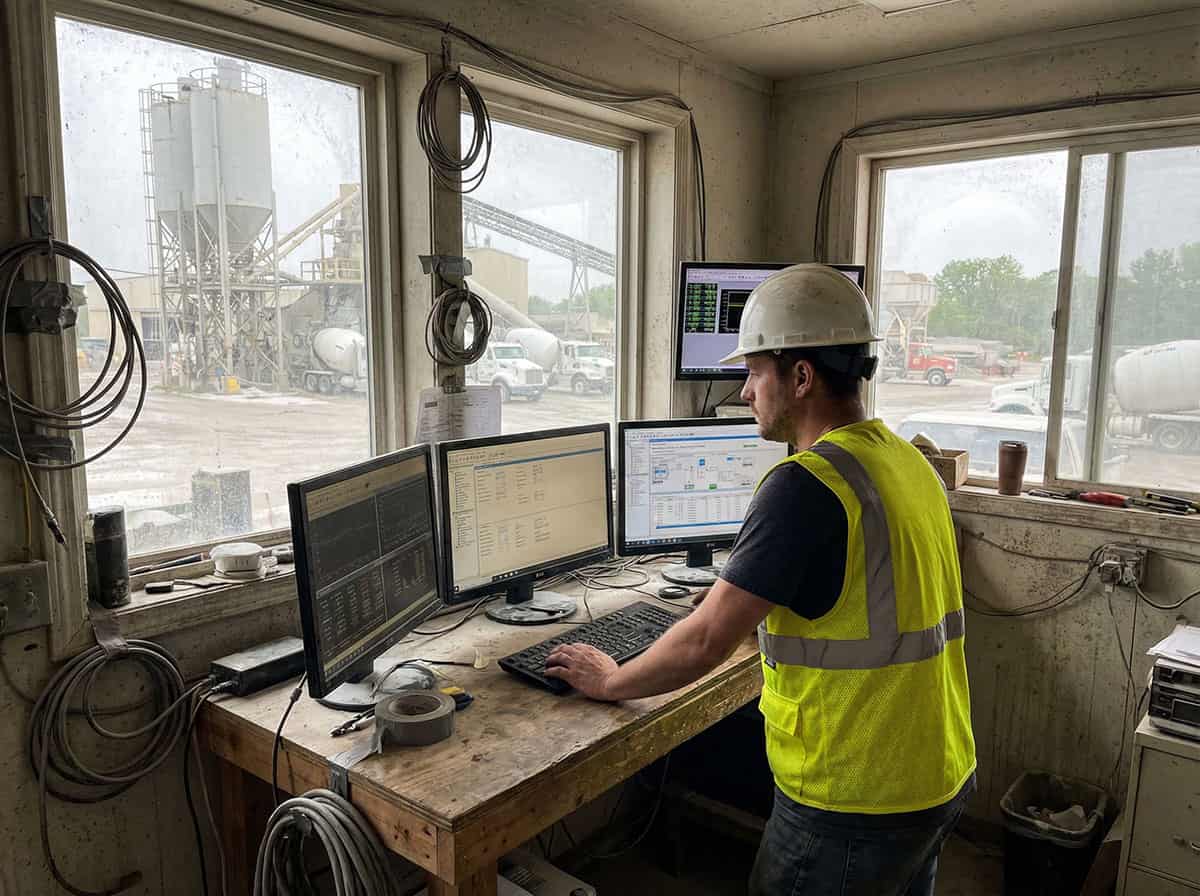
Concrete plants are not office environments. Dust, heat, humidity, and vibration affect hardware in ways that standard IT deployments don't account for. A workstation that performs reliably in an air-conditioned office for five years may last 18 months in a dispatch booth that's getting dust from the batch plant and temperature swings from the yard.
A general IT provider speccing hardware for your plant is making educated guesses. A specialized provider knows which hardware holds up in industrial environments, how to position and protect equipment to extend its life, and what the failure patterns look like so you can plan replacements before you're dealing with emergency procurement. That extends to your network infrastructure too — plant-grade LAN and WAN management looks fundamentally different from designing a network for a standard office building.
The same applies to wireless networks. Covering a plant with multiple buildings, a scale house a quarter mile from the office, and concrete structures everywhere in between requires a different design approach than covering a single-floor office building. Getting wireless wrong in a plant environment means unreliable connectivity to dispatch terminals, driver tablets, and scale systems — and intermittent connectivity is often harder to diagnose and more damaging to operations than a complete outage.
The Schedule Problem
Concrete operations don't run 9 to 5. Pours start early. Weekend work is common. Seasonal demand peaks create periods where uptime is more critical than ever and the cost of any disruption is highest.
General IT companies typically offer business-hours support with an after-hours emergency line that may or may not connect to someone who can actually help. For a concrete producer, that model is structurally misaligned with your actual operational risk. Your highest-risk moments — early morning before a major pour, late-season pushes, weekend commercial work — are exactly the times when generic IT support is least available and least equipped.
A dedicated IT partner built around industrial operations runs 24/7 support as a core offering, not an add-on. Because their clients all share the same operational profile, the economics of round-the-clock coverage work differently than they do for a general MSP trying to serve law firms, retail businesses, and concrete plants under the same support model.
What Specialized IT Support Actually Looks Like
It looks like a technician who picks up the phone at 4 AM and already knows your plant's network diagram. Who can pull up your server health history and tell you whether this is the first sign of a problem or the third. Who knows that your Command Alkon system runs on a dedicated server that cannot be rebooted without a specific shutdown sequence, and who has that sequence documented from your onboarding.
It looks like quarterly reviews that account for your production calendar, not just a generic IT checklist. It looks like hardware recommendations that factor in your plant environment, not just your user count. And it looks like proactive cybersecurity and threat assessment that accounts for the specific risk profile of an industrial operation — not a one-size-fits-all security audit built for a law firm.
Most importantly, it looks like an IT partner who understands that their job isn't to manage technology — it's to keep concrete moving.
If your current IT support doesn't know what a batch controller is, it might be time for a different conversation. Take a look at what dedicated IT services for ready-mix concrete producers actually looks like.